Three campaigns running · one new finding worth a look, one awaiting your call.
Active
3
Experiments
42 +6
Verified hits
16
Papers
3
Compute · Aug
$310
What should we research?
Ask about a result, or describe an idea — Raftel plans it, estimates the cost, and runs it end to end.
Raftel plans and runs campaigns; results are certified by the sealed verifier.
Worth a look
New pitch · your callQuantum photonics
One cold day to find your best five devices
His flagship array works 36 of 36, but only a handful of devices ever get the full quantum-optical workup — each costs cryostat-hours. Can a measurement-scheduling policy recover the best five and predict the rest under a hard 24-hour budget?
24hbudget · vs ~265h to measure all
→ open the pitch
New pitch · your callQuantum networking
A better policy for gates teleported between chips
Her unconditional CNOT between two diamond nodes runs at one good event every ~30 s, on a policy set by intuition. Can a loop find a schedule that beats the published protocol at fidelity — in a model calibrated to her real numbers?
>70%baseline CNOT · policy search, sim-first
→ open the pitch
Featured demo · your callHigh-energy physics
Seven cheaper wormhole-teleportation circuits
Starting from a published sparse-SYK "wormhole on a chip" instance, the harness found seven verifier-certified variants that run on ~14% fewer gates (48 vs 56) while still passing every chaos and wormhole test. It ends in a written paper — included in the repo.
7certified · 14% fewer gates · paper ready
→ open the demo report
In queue3 running
Two pitches in challenge, three campaigns live
qd-array-screening & telegate-policy sharpening in the challenger; prism-trpl-recipe, three-kerr-qe, qei-lean scoring on the blinded verifier.
1,240evaluations today
→ view queue
Latest results
◇
Screening pitch sharpened over three challenge rounds qd-array-screening · rev3
the science survived every round; the adversary is down to certificate bookkeeping
in review today
◇
Teleported-gate policy · challenger credited the fixes telegate-policy · rev2
caught one real herald-rate bug — being pinned against the paper
Over-pruning caught by the sealed verifier dhruv · EXP-0003
a 53-gate circuit looked fine but fidelity fell to 0.31 — refused
refused today
·
Contact-loss model refuted at the premise dq-voc-residual
challenger proved 5 points can't fix a 2-parameter model
rejected 1d
+ 37 earlier results · didn't-works collapsed
In the queue
prism-trpl-recipe
perovskite · search
1,240 evals88%
three-kerr-qe
gravity · cycle 11
score 70.046%
qei-lean
formal · cycle 14
score 60.161%
← Overview
The approach
What we found
Deliverables
How it ran · agents in parallel
AI-time 00:00 / 2d
EXPERIMENT LEDGER · blinded scorekeeper
best —
← Overview
Proposal · draftMaterials · perovskite · draft
Fewer measurements, same implied voltage
In one line
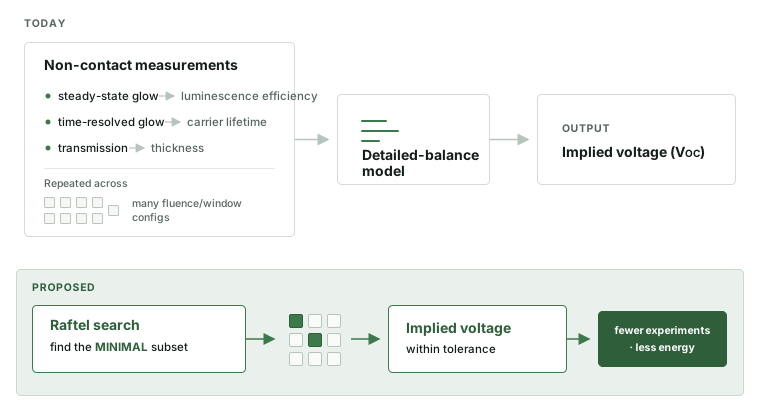
A published method infers a perovskite device's operating voltage (V_OC) from three non-contact optical measurements, each repeated across many settings. We propose searching for the minimal subset of measurements and configurations that still recovers implied voltage within tolerance — cutting experiment count and energy. Scroll for the plan, the bar it must clear, and the cost.
Every subset of {steady-state glow, time-resolved glow, transmission} — can two of three carry the implied voltage?
How many configurations
Fluence × acquisition-window settings per measurement — from today's many down to a minimal set.
Acquisition budget
Total measurement time and light dose, as an explicit cost the search minimizes.
Robustness
Across a grid of realistic device stacks + measurement noise, scored leave-one-device-out.
Condition to succeed — the bar it must clear
A subset wins only if it is provably good, not merely plausible.
It must recover implied voltage to ≤ 10 mV out-of-sample (leave-one-device-out) using ≤ 2 measurements and a strictly smaller acquisition budget than the full three-measurement protocol.
Anti-hallucination guard: at import, the sealed verifier must first reproduce the full-protocol implied voltage on a held-out device (a dress rehearsal). If it can't, it refuses to run — so a reported "win" can never be an artifact of a broken forward model or a lucky fit.
Time & resources
Total time
~6 hours, start to paper
Fully automated · no hardware or vendor step in the loop.
Resources
1× A10G GPU · ~3 GPU-hrs
Batched forward-model inversion; CPU fallback. ≈ $9.
Simulations & datasets it needs
A 1-D carrier-diffusion + detailed-balance forward model over a grid of synthetic device stacks with realistic measurement noise. Grounded on the published batch data (arXiv:2508.21037).
Lands as
Paper + reduced protocol
The minimal recipe with error bars + a repro repo — or an honest floor.
On approve: pre-register the hypothesis to git → freeze the sealed verifier → run the search, agents in parallel. You stay in the loop on every promotion.